| Author: | Ralf Südhoff |
| Date: | 16. January 2026 |
Well, what now? After Development Minister Alabali Radovan presented her strategy for realigning German development cooperation at the beginning of this week, the public response ranged from “no more scattergun approach” to “pressing ahead” to praise from the research institute IDOS funded by the Federal Ministry for Economic Cooperation and Development (BMZ). The general criticism came mainly confidentail, from aid organisations – and from the BMZ itself, with feedback ranging from “unclear” to “doesn’t make sense.”
So, who is wrong? And how did this realignment, which was ultimately presented very quickly and is supposed to address the fact that German development policy is “at a strategic turning point,” come about in the first place?
Flashback: After the BMZ could only be retained in the coalition negotiations against the will of CDU/CSU party, the new SPD Development Minister announced a “reorientation” of development cooperation in 2025. The coalition agreement already set the course with its focus on German business opportunities, security policy, and German interests, seconded by the CDU-affiliated Konrad-Adenauer-Stiftung.
Nevertheless, an internal debate began within BMZ including modern “reform sprints,” but was outpaced at the end of November at Werderscher Markt: To the astonishment of the entire BMZ (and 99% of the Foreign Office), the Foreign Office presented a comprehensive reform plan for the ministry in the spirit of an “interest-driven foreign policy.” One of the most significant changes in-house was the abolition of Department S, which was responsible for all BMZ related issues like humanitarian assistance, stabilisation and peace programs, and the Nexus Unit for interministerial coordination.
The pressure on the BMZ to react was correspondingly high. Promptly, in December, it was announced that it would present its own reform plan right after the Christmas break.
So last week BMZ staff has been informed about the plans the same morning just before the minister briefed Berlin media. According to BMZ employees, this was another reason why the “mood was very bad” at the meeting. It hardly improved with the presentation itself.
Criticism of process, priorities, and the new structure
Criticism of the new “strategy” concerns its process, prioritisation, and the planned new structures. The minister did not speak publicly about the latter, so more on that later.
The accelerated process described above was in line with an internal debate on the culture of participation, which employees perceived as a clear step backward compared to the era of minister Svenja Schulze: “It is difficult to see a connection between the process and the result,” critics say, “many priorities were obviously set from the outset.”
Plus, these priorities are quite an epochal change. Right in the first paragraph of the foreword, the minister emphasises: “Development policy is thus an integral part of German security policy (…)” And under Goal 2 of the strategy, “Peace and stability – promoting sustainable security,” it explicitly states: “Hence, the German development policy will be more strongly oriented toward security policy (…)”.
Among the four goals of the future German development cooperation German business opportunities are another priority, as development policy offers “concrete points of contact for the involvement of German companies.” In addition to the rather vague priority of “strategic alliances” – which essentially involves setting up a North-South Commission at some point in 2026 – the overarching goal is to “overcome poverty, hunger, and inequality, and protect the rule of law and civil society spaces.”
So, is the BMZ remaining true to its core mission of combating poverty and hunger after all?
To date, the BMZ partners only with 27 of the 44 Least Developed Countries (LDSCs), despite having a total of 65 partner countries. Only three of the ten largest recipients of German official development assistance (ODA) funds belong to this group. VENRO has criticised in the past, that “Germany’s contribution to these countries has remained well below the international commitment of 0.2 percent of gross national income (GNI) for years.” And in future?
The strategy paper devotes only a single column to the supposedly new focus of the strategy, the LDCs. Beyond vague references to “value partnerships,” “local value chains,” and “strengthening voices,” this column only specifies in more concrete terms that the existing special initiative “Transformation of Agricultural and Food Systems” will be maintained.
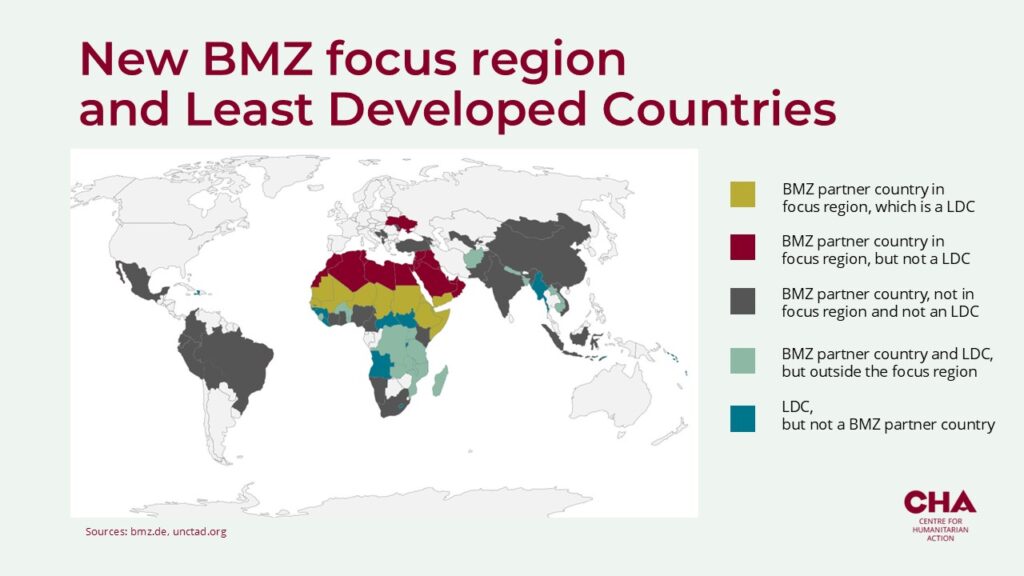
The paper is much more specific when it comes to future funding cuts due to budget constraints, many of them related to poverty issues. One of the most groundbreaking announcements in the strategy is a new comprehensive regional focus on geopolitically relevant neighbourhoods of Germany and Europe: the Sahel, the Horn of Africa, the Middle East, and Europe itself. Even LDCs outside these regions that were previously BMZ partner countries will be clearly deprioritised, including countries facing enormous challenges such as Bangladesh, Afghanistan, etc. And regarding an entire range of sectors strongly relevant to poverty, the strategy explicitly states: “Bilateral cooperation with individual partner countries in the health sector will be terminated as a matter of principle,” as will all bilateral programs for food security “outside the aforementioned focus regions.” Moreover, “BMZ’s commitment to social security programmes in other regions of the world will also be terminated.”
Overall, according to CHA analyses a closer look reveals that 34 of the 44 LDCs worldwide will no longer be included in the new regional BMZ focus (see chart “New BMZ focus region and Least Developed Countries”). Is this what a strategy for combating poverty in LDCs looks like?
Furthermore, an alleged focus on LDCs hardly matches with new interest-driven priorities such as German business opportunities. German companies are least interested in poverty-stricken regions due to a lack of market opportunities. According to the Fragile State Index (FSI) Index, almost all LDCs are among the most fragile states in the world and are therefore countries in which no company likes to invest for the very reason to be too fragile. Even in the new focus regions, there will be few business opportunities in LDCs, as a BMZ employee responsible for a focus area confirms: “It doesn’t make sense: we have gone through this up and down for our region, and there is not much to be gained. Plus, overall it’s not clear how the strategy is supposed to prioritise LDCs.”
Following in Niebel’s footsteps
With the new focus on German business opportunities, the minister is also closing the circle with her predecessor in office, Dirk Niebel (FDP), probably the most hated former development minister by SPD party members. Back in 2010, Niebel advocated for prioritising German business opportunities and “interlinked security,” which he also exemplified by wearing his old paratrooper cap from his time in the German Armed Forces on ministerial trips. Accordingly, there was also currently strong resistance within BMZ to heavily involvement of the private sector, with the country departments protesting the “stereotypical approach” in an internal BMZ paper.
New strategy, old concepts
Overall, it is striking how many aspects of the “new strategy” are simply a rehash of old initiatives: the announced “nutrition initiative” is already running at BMZ since 2013 under Gerd Müller’s aegis. The idea of a North-South Commission was first proposed by Willy Brandt in 1977. A new focus on cooperation and partnerships – “away from projects, toward strategic alliances”? This echoes the “international structural policy” once proclaimed by Minister Heidemarie Wieczorek-Zeul (1998 to 2009) instead of small-scale “projectitis.”
While such approaches were well-founded at the time in the context of a far-reaching international “global governance” debate, the new strategy paper reveals how contradictory this and many other approaches and statements appear:
On the one hand, the ministry promotes alliances instead of projects – on the other hand, it names “German bilateral development cooperation with a strong local presence” as its unique selling point.
On the one hand, the minister emphasises that funds should no longer be allocated on a “scattergun” basis (a description that did not win her many friends internally). On the other hand, the long list of 65 countries remains in place.
On the one hand, the BMZ will allegedly expand its cooperation with civil society and NGOs, including local actors. On the other hand, multilateral approaches are prioritised in core areas.
On the one hand, it wants to seek “direct exchange with citizens (…)” on the ground in the future; on the other hand, it is pursuing this ambitious goal “especially in fragile partner countries” – where such a participatory revolution is likely to be most difficult to implement.
On the one hand, mutual interests and cooperation priorities are to be agreed with partner countries on an equal footing in a “new form of partnership” and a transparent policy of national interests. On the other hand, the vast majority of partner countries are highly fragile states with limited governance; according to the FSI Index, the five most fragile states in the world are all BMZ focus countries. Only four BMZ partner countries are considered stable at all (see chart “BMZ partner countries on the FSI Index”).

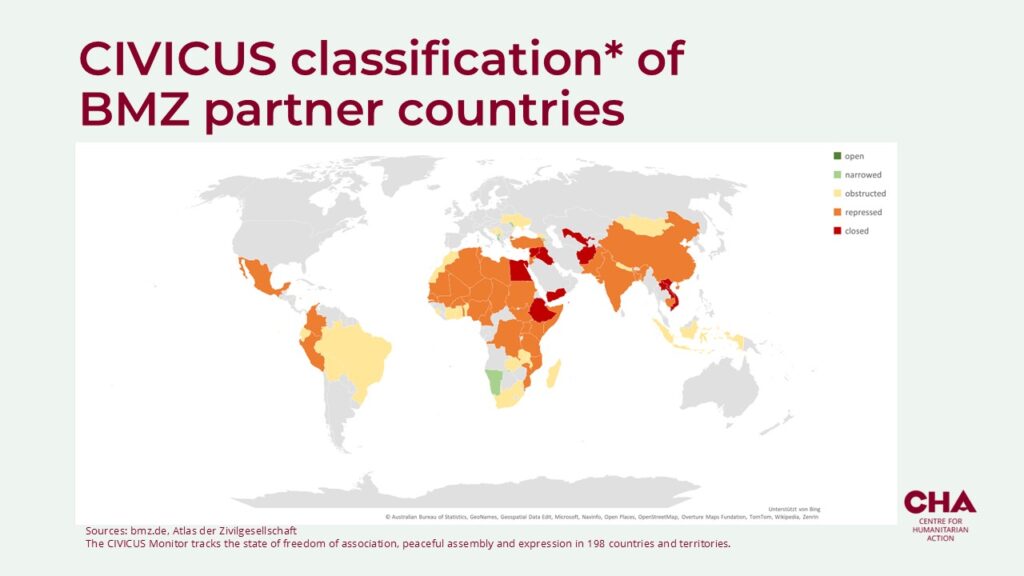
Furthermore, the “new partnerships” are to be established with governments that represent the interests of their populations only to a very limited extent: in 51 of the 65 BMZ partner countries, civil society is considered “oppressed” or society as a whole is even considered ‘closed’ according to the latest CIVICUS report (see chart “CIVICUS classification of BMZ partner countries”). So, who is the legitimate partner for the propagated future joint definition of interests? Not to mention the challenge how cooperatively BMZ will react if its once again underlined priorities like feminism, climate protection and the promotion of democracy will be met with even less approval in future interest-driven government negotiations?
The BMZ is not to blame for these growing international conflicts of interest and areas of tension. However, it is highly blameable if it ignores them.
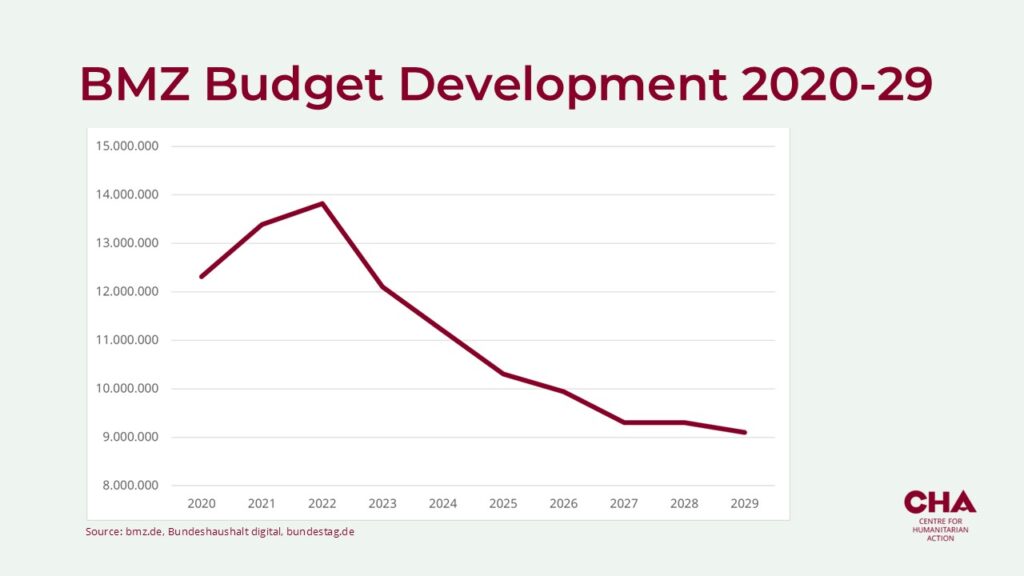
Annegret Kramp-Karrenbauer, chair of the expert commission “World in Transition – Germany and the Global South,” also emphasised this week in the Bundestag Committee on Economic Cooperation and Development that there are partners who “by no means share German values.” It is important to “be aware of this balancing act and deal with it.” Moreover, Germany must “become more involved internationally” (Alabali Radovan herself had accepted the further upcoming budget cuts as a given at the Federal Press Conference, see chart “BMZ Budget Development 2020-29”).
It is these trade-offs and tensions precisely, that think tanks have been grappling with for years in an aim to analyse options for non-governmental cooperation in times of authoritarianism and network approaches, for effective assistance even in fragile states, for “mutual interest” concepts and their limitations. No one can present simple and universal solutions here. However, the big problem with the so-called new BMZ ‘strategy’ is that it suggests all these conflicting goals are non-existent or can be resolved with phrases of “identical values and interests.” “Of course there are clear conflicts of interest,” confirms a BMZ department head, citing a concrete example: “Do we use our declining budgets where we can most effectively help the poorest of the poor – or at a hub for migrants on their way to Europe?”
Anyone who ignores such fundamental conflicts of interest in a strategy for 2026 is not, as claimed, repositioning its policy in light of new challenges, but rather shying away from them. This dilemma is also likely to be reflected in the new structure of the ministry.
New priorities, new structure
While the minister spoke almost exclusively about substantive priorities in addressing the public, a new structure was presented at the staff meeting that same morning. However, this was done only by a “mini organisational chart” (one employee) that names new departments, while almost everything at lower levels below appears to be in flux.
In line with the prioritisation, a new thematic department for “Reconstruction and Stability” is being created, which could indeed helpfully integrate some instruments in these areas. Moreover, all focus regions are being combined in the same department, while a new department for “bilateral cooperation” is being created for all remaining programmes in Asia, Latin America, and Africa beyond the new focus regions. Internal working title among BMZ staff: “The leftovers department.”
Other new thematic departments include a department for “Global Alliances and Economy” and a new unit for analysis and early crisis detection, while major regional units such as the Africa Department are being abolished. This raises further questions, also in relation to BMZ cooperation with the Federal Foreign Office. The latter has taken exactly the opposite approach, strengthening its country departments at the expense of thematic units and abolishing the department for stabilisation programs, humanitarian aid, and peacebuilding. A senior official from the BMZ’s peace department is surprised: “It’s interesting that one ministry is getting rid of its stabilisation unit, while the other is setting up a crisis prevention/stability unit…”
As much as internal and public feedback on the reform may differ in some respects, experts and media representatives agree on one point: the guiding principle of the new BMZ strategy is how BMZ itself can be preserved. “It’s really striking how this point has dominated all the debates on this issue,” deplores a BMZ representative.
Looking at this strategic issue, you might also ask whether the minister has done her ministry any favours with her extreme adherence to an all-encompassing new business and foreign policy focus? Even at the generally very well-disposed Federal Press Conference, the question has been raised at the end what value a BMZ still had as an independent ministry since it appears so strongly oriented toward foreign policy interests?
The minister repeatedly referred to the “presence on the ground” of GIZ, KfW, and the development cooperation advisors that BMZ delegates to selected German embassies.
The Foreign Office and the Ministry of Economics will have followed this reasoning closely. In future CDU politicians and ministers may argue more forcefully than ever that they would be very happy to integrate German development cooperation and its organisations into the long-established global institutions and networks of their own ministries, like 225 foreign missions of the Foreign Office and 150 chambers of commerce abroad.
Internally, some frustrated employees fear that “this is not a smart strategy for the preservation of BMZ.”
_____________________________________________________________________
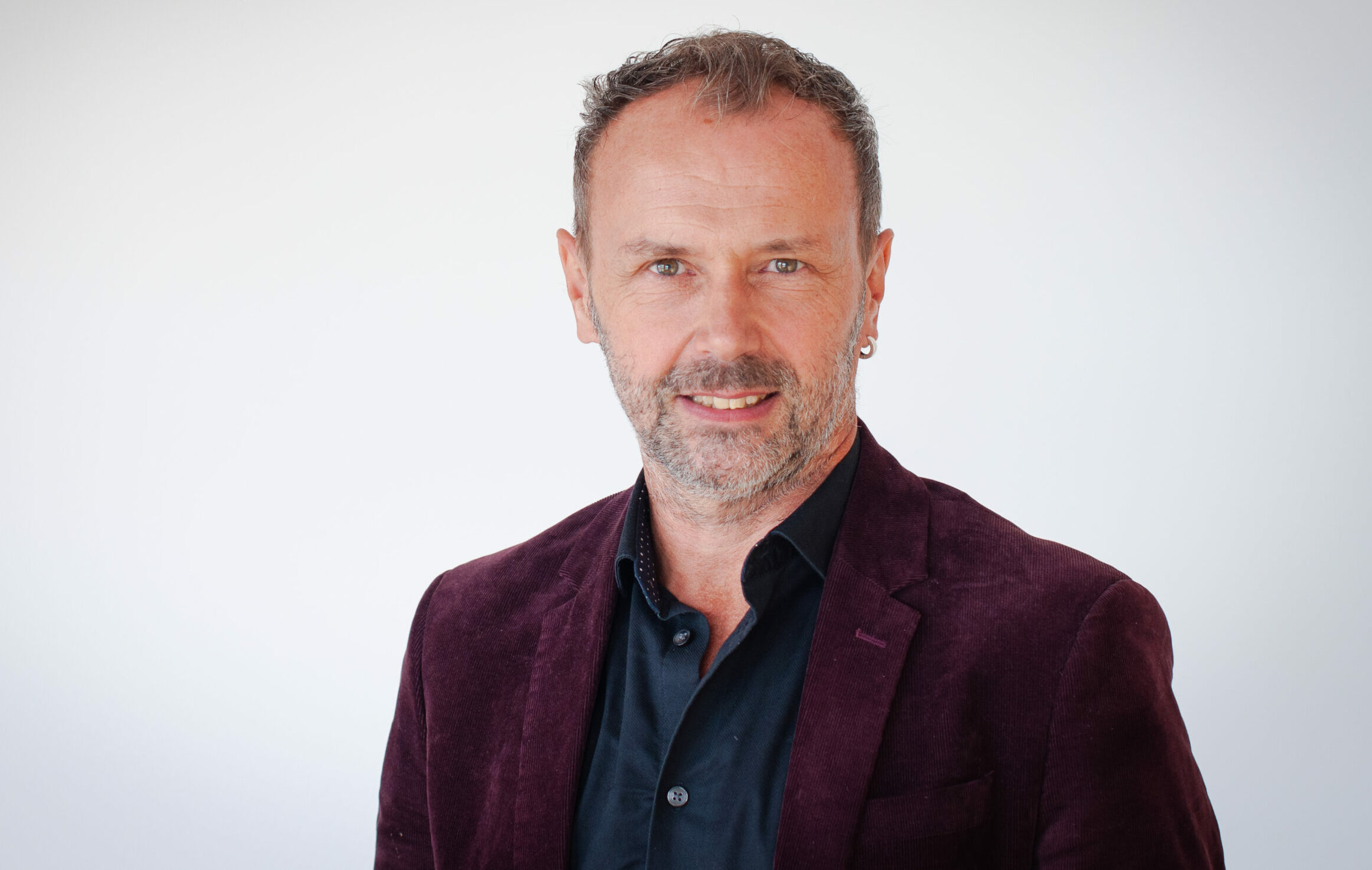
Ralf Südhoff is director of the Centre for Humanitarian Action (CHA).
Contributions by Anne Tritschler, Lena Koperek und Philipp Möller.
Related posts
CHAtroom #25: Contested Aid with Jan Egeland
12.12.2025Ralf Südhoff among the TOP10 NGO heads in 2025
04.12.2025The fading of the Humanitarian Reset
16.10.2025