| Author: | Sonja Hövelmann |
| Date: | 13.11.2026 |
| Downloads: |
Paper (DE)
Executive Summary (DE) Executive Summary (EN) |

How can German aid organisations make a strategic and formative contribution to the humanitarian system?
For humanitarian nongovernmental organisations (NGOs), an era of growth is coming to an end. With the dissolution of USAID, a retreat from multilateralism and drastic cuts of 30–40 per cent in public humanitarian funding, the operating space available to civil society actors is undergoing a fundamental transformation.
This study examines how aid organisations based in Germany – in what was once the second-largest donor country – contribute strategically and shape humanitarian policy, and how well-equipped they are to respond to the current crisis. After years of growth fuelled by an expansion of public funding, these organisations now face the challenge of consolidating their institutions, recalibrating their relationship with the political sphere, and positioning themselves for the future in a changing world order in which, for the time being, they must navigate largely by sight.
The study identifies both obstacles and opportunities and offers recommendations for positioning German civil society-based aid in a strategic and sustainable manner.
Key findings
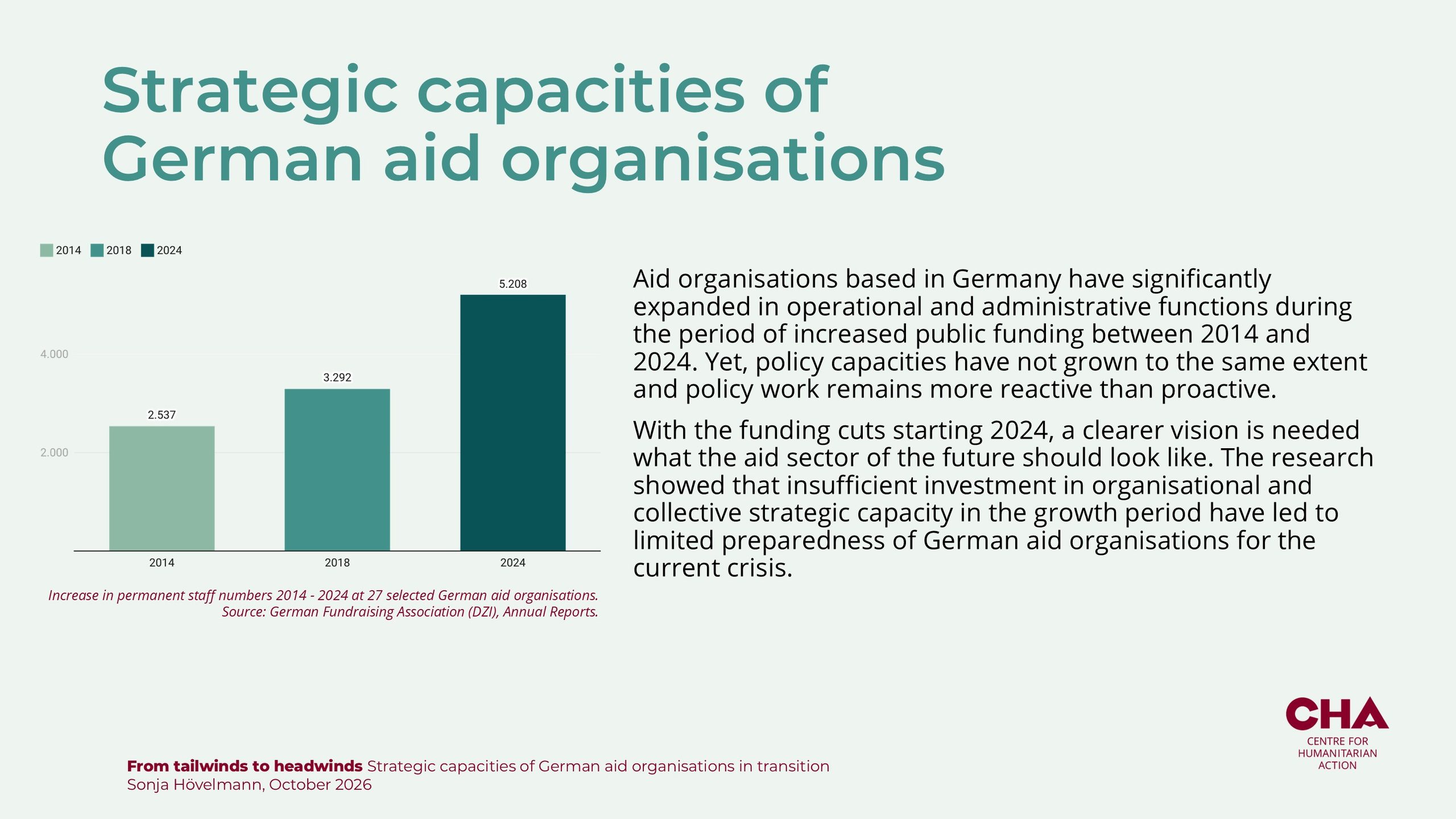
Aid organisations based in Germany have expanded significantly in both staffing and organisational structures during the period of increased public funding between 2014 and 2024, particularly in operational and administrative functions. Although policy capacities have also been strengthened, they have not grown to the same extent and remain more reactive than proactive. As a result, international policy discourses receive greater attention, but distinctly German positions are only rarely brought into global processes.
Structurally, three factors hinder the development of greater collective strategic capacity within the German aid sector: incentive structures that reward growth rather than impact; a fragmented landscape of actors that makes it difficult to build common positions; and a consensus-based culture that often produces the lowest common denominator.
Within the parliamentary arena, there is a lack of coordinated and concerted approaches, and despite good channels of access to parliament, this has not translated into greater influence. A long-standing symbiotic relationship with the Federal Foreign Office has, to some extent, constrained strategic autonomy. Towards the end of the period under review, however, the advocacy work on Gaza from 2023 onwards, together with a shift in the foreign policy self-image reflected in the 2024 Humanitarian Strategy, mark a turning point.
The key findings of the study in detail are as follows:
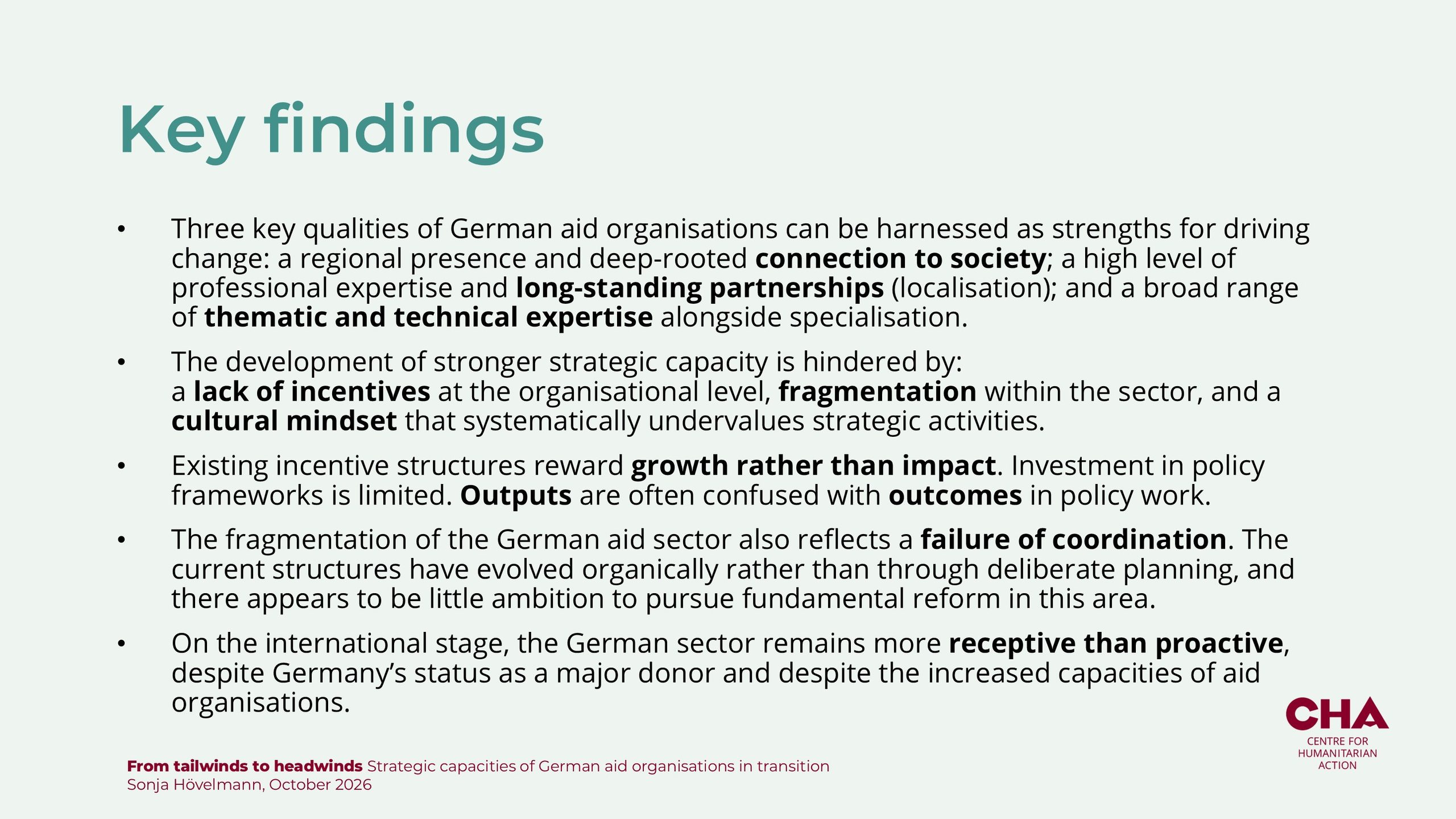
- The German aid sector suffers from a threefold structural weakness that hinders the development of stronger strategic capacity: a lack of incentives at the organisational level, fragmentation within the sector, and a cultural mindset that systematically undervalues strategic activities.
- Existing incentive structures reward growth rather than impact. The logic of the charity market, German non-profit governance and dependence on donor funding result in limited investment in policy frameworks. In policy work, the focus is too often on output rather than outcome.
- The fragmentation of the German aid sector is not merely a question of limited capacity; it also reflects an overload of coordination. The current structures have evolved organically rather than through deliberate planning, and there appears to be little ambition to pursue fundamental reform in this area.
- On the international stage, the German sector remains more receptive than proactive, despite Germany’s status as a major donor and despite the increased capacities of aid organisations.
As a sector, German aid organisations combine, amongother things, three key qualities that can be harnessed as strengths for driving change: a regional presence and deep-rooted connection to society; a high level of professional expertise and long-standing partnerships (localisation), reflected in the high standards of their project work; and a broad range of thematic and technical expertise alongside specialisation.
With the funding cuts introduced from 2024 onwards, there is still no clear vision of what the aid sector of the future should look like. The red pencil is being applied to the status quo rather than to a genuine reorganisation. The failure to invest in collective strategic capacity during the period of growth has left German aid organisations structurally ill-prepared for the current crisis.
Recommendations
German humanitarian aid organisations are under dual pressure to adapt. In the short term, shrinking resources are forcing them to consolidate and improve efficiency. At the same time, they must take a more fundamental look at the outcomes they seek to achieve and the structures that will be required to achieve them over the medium term.
The study proposes five approaches to support this transformation:
- Redefine the role and purpose of German humanitarian aid organisations in the post-Aid era.
- Critically examine the fragmented programme and project logic that lies at the core of humanitarian work.
- Align technical specialisation with the collective effectiveness of the German sector – consortia alone are not an adequate response to fragmentation.
- Recognise that effective policy work requires a shift in mindset: humanitarian action is inherently political and must be advocated as such.
- Clarify whether aid organisations primarily see themselves as state-affiliated implementing partners or as part of an independent civil society facing an increasingly challenging environment.
Methods in brief
The study examines how the strategic and policy capacities of German civil society aid organisations have developed between 2014 and 2024. Methodologically, it combines a fact-based survey with data analysis and 26 expert interviews. The focus is on 27 aid organisations based in Germany that, by virtue of their size and turnover, have the potential to play a decisive role in shaping German humanitarian aid.
Take Aways
(Mouseover to pause)