
| Author: | Ralf Südhoff |
| Date: | 18. June 2026 |
Once upon a time, there was a small German boy who was very popular in the neighbourhood. He was a good friend, a good listener and someone who was always willing to help friends in need. But the older boys at school began fighting more and more often with the rival school down the road, which was asking for trouble. So the older boys pressured him to join them. The boy decided to start going to the gym with the older boys every day and to spend all his money on protein instead. He told everyone else in the neighbourhood that, in these tough times, they would now have to look out for themselves. But soon he noticed, to his surprise, that the older boys still did not take him seriously. And his former friends no longer wanted anything to do with him.
So, what happened? And what does this have to do with Germany’s historic defeat in the vote for a seat on the UN Security Council?
Of course, one can look for an easy way out and claim that Russia, the lack of a Merz visit, or even the previous government are to blame. But one could also ask a more fundamental question: in its entirely legitimate drive to build military and geo-economic strength, has the geopolitically still small boy Germany possibly forgotten all about its soft power—the very quality that once made it unique?
Analogies always oversimplify, and no one knows exactly how individual states voted in the secret ballot. Many such votes are negotiated through transactional deals, for which Germany actually can mobilise far greater resources than its successful competitors, Austria and Portugal. All the more reason, then, to ask what lessons Germany should draw from the New York disaster. Should it simply run for the seat earlier next time?
A far more plausible explanation is one that some experts had already impressed upon the federal government and the “Zeitenwende” well before the UN vote: anyone who believes they can neglect their soft power in order to invest in hard power will, in the end, be left largely powerless.
It was not for nothing that the previous German government adopted a National Security Strategy that defined a modern foreign and security policy covering soft power issues of international cooperation, climate and cultural policy, eye-level partnerships and peacebuilding. The previous government translated this vision into action only to a limited extent. But the new German government, despite far greater budgetary leeway, has now largely dismantled what was once the leading “soft power superpower Germany” (Global Soft Power Index 2021). It has done so deliberately, framing public debates as a choice between “do-gooderism” and “national interests”, a “woke NGO landscape” and AfD voters, and so on.
Unlike its competitors, which have different international profiles, Germany has fallen into a credibility trap. Missteps have always occurred from time to time, but today the federal government seems to stumble from one such trap to the next.
A very incomplete list of examples:
Alongside the traditionally interest-driven European middle powers, France and the United Kingdom, Germany sought a seat on the Security Council on the grounds that it was the guardian of international law and a rules-based world order. In the past, this argument convinced voters in every candidacy. Germany, often described in international surveys as an “honest broker”, was consistently elected. Today, however, Germany picks and chooses international law à la carte, applying it when it supports its stance against Russia, while regarding it as secondary or too “complex” when the United States intervenes in Iran or Venezuela, or when Israel commits war crimes in Gaza and faces allegations of genocide. For Craig Mokhiber, former director of the New York office of the UN High Commissioner for Human Rights, this “scandalous behaviour” alone made Germany’s defeat a “rare moment of justice”.
But the trend goes back much further. While Germany continues to present itself as a force for peace, it has cut investment in peacebuilding and prevention by 40% compared with 2022. While Russia has due to estimates recently quadrupled its investment in education and media programmes abroad, and China has increased its foreign affairs budget every year since 2021, Germany continues to scale back its own funding. While Berlin was considered a leader on international cooperation only a few years ago, it now—as self-proclaimed ‘guardian of international rules’—ignores the international commitment to spend 0.7 % of gross domestic product on development cooperation, and cuts this figure year after year. And while the coalition agreement promises “adequate” humanitarian aid, the government has slashed it by 53%.
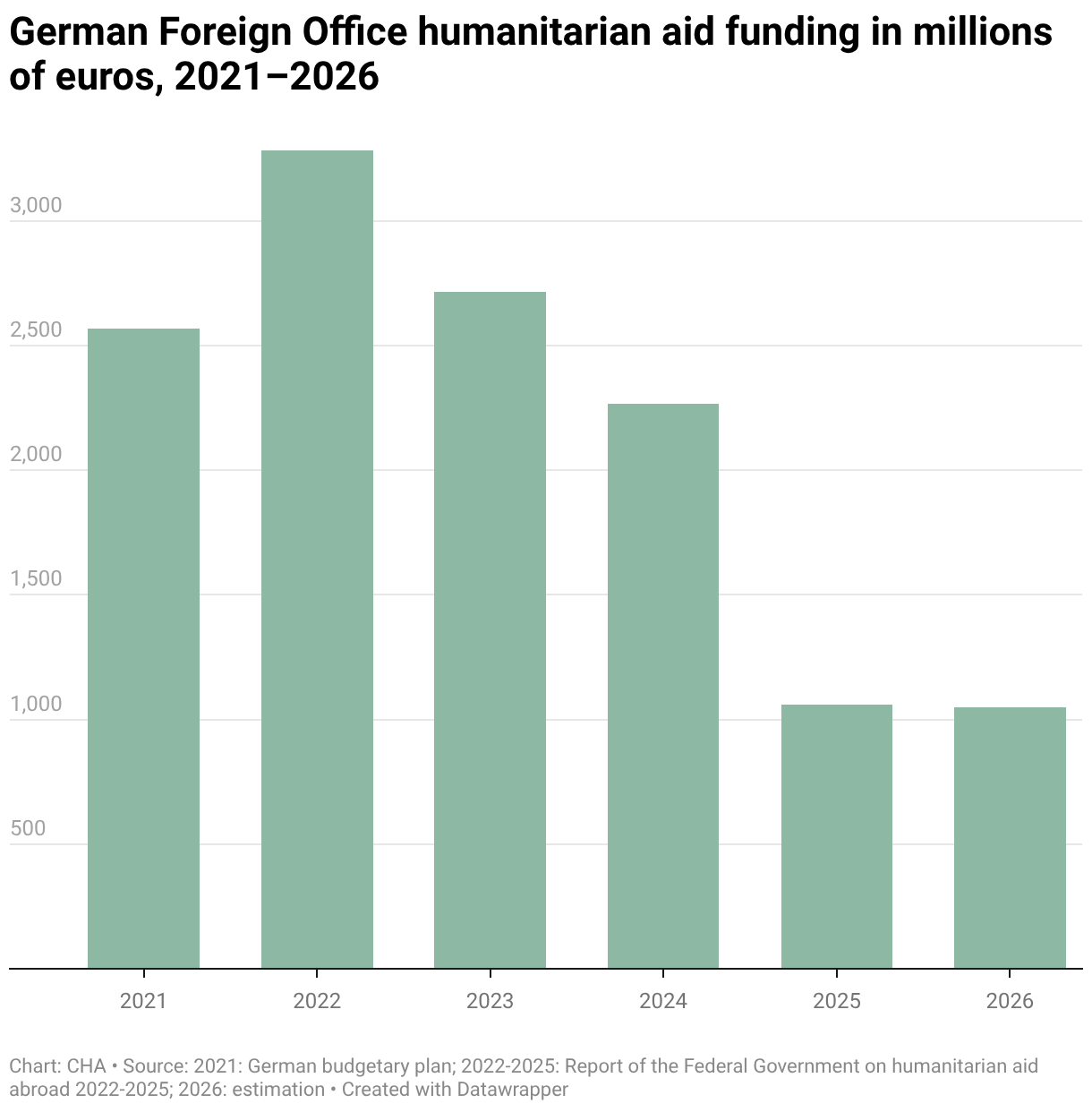
This is good news above all for other states that are strategically moving into the gap. It is no coincidence that, in 2025, Germany was overtaken by Saudi Arabia and the United Arab Emirates and dropped to 6th place.

Chart: ALNAP Sources: OECD DAC, UN OCHA FTS und UN CERF
And the funds that remain with the Federal Ministry for Economic Cooperation and Development (BMZ) and the Federal Foreign Office? According to their latest strategy papers, these resources will explicitly serve geopolitical objectives and “national interests”. Trump’s transactionalism sends its regards. What, exactly, did Germany want to be elected for again?
Experts beyond the aid sector, including former German UN ambassador Christoph Heusgen (“Double Standards”) and former director of Germany’s leading foreign affairs think tank SWP, Volker Perthes, argued that Germany’s lack of consistency on international law and international commitments played an important role in its election defeat. “The cuts to development cooperation and humanitarian aid are particularly striking. Anyone who defines international influence largely in terms of financial contributions will also come under particular scrutiny when those contributions fall”, Perthes highlights.
When it comes to soft power itself, a major strategic gap has also been evident for years. The concept of ‘soft power‘, developed by Joseph Nye after the Cold War, rests not only on long-term investment in international relations but also on the ability to persuade and attract others through networks and alliances. Yet even in its strongest years, Germany made too little of its soft power relative to the scale of its investments.
According to numerous analyses, “inertia and complacency” led to a lack of coordination, review, and strategic thinking, as critics including Berlin’s Hertie School have argued. Particularly striking is the fact that, even during its strongest years, Germany faced criticism at UN headquarters in New York for failing to deploy its soft power strategically.
“They are more of a quiet power”, one New York-based donor representative told CHA. “I almost never get an invitation to the German mission, coordination doesn’t exist”, marvelled the representative of a top donor, noting that financially much smaller actors such as Sweden or Switzerland, but also China, were much more active.
Representatives at other UN locations and hubs across the Global South make similar observations, arguing that Germany understands too little about the relevance of networking and “wining and dining”. It was no coincidence that, in the week before the UN vote, Foreign Minister Wadephul scrambled to make up ground with more than 100 meetings in New York, capped off by a pretzel reception at the German mission.
Of course, Germany indeed needs to reposition itself in the field of hard power (military and economy). The old role of the invisible “everybody’s darling” (Süddeutsche Zeitung) no longer works. But it is a fallacy, as the Institute for Foreign Relations (ifa) has argued, to assume that “the importance of soft power is declining as a result – the opposite is the case”. Instead, Germany and Europe should seek to fill the vacuum left by the United States and show that they want to “shape the global public goods of the twenty-first century as a principled and pluralistic actor”.
Otherwise, a free fall could be a realistic scenario. Just five years ago, Germany ranked first in the Global Soft Power Index, thanks above all to leading the categories “helpful to other countries”, “respected leader”, and economic strength. Today, Germany has slipped in all of these categories and now ranks three places behind China in the 2026 index. “China is increasingly perceived as a predictable, reliable partner that can deliver tangible benefits”, the authors note, while Germany “demonstrates how economic and diplomatic credibility can erode at the same time”.
All the trends outlined here point to one conclusion: Germany has dramatically underestimated the importance of expanding, rather than reducing, investments in its “soft power”, precisely in order to exert influence in today’s far more conflict-ridden arenas of “hard power” – and to be elected for the latter.
This is especially true for a Germany that will need many more years before it can regain significant influence in the military and economic hard power arena.
To return to the analogy: The German boy absolutely needs to go to the gym and build more muscle for a far rougher future. But he should not fall for the slogan recently used by a Berlin gym chain to attract teenagers with the German pun: “We don’t talk, we lift”.
________________________________________________________________________
Ralf Südhoff is director of the Centre for Humanitarian Action (CHA).
This article was first published in a shorter version at Berlin.Table
Related posts
Talking poverty, meaning national interests
16.01.2026The fading of the Humanitarian Reset
16.10.2025German Humanitarian Action